
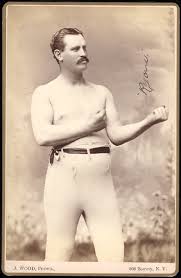

In the nascent days of gloved boxing, establishing and maintaining a championship claim was a Herculean task. The sport grappled with unreliable record-keeping and the constant threat of police intervention. Following Jem Mace’s unification of the British and American titles in 1870, and his subsequent retirement for paid exhibitions, the heavyweight division lacked a consistent, recognized champion. Into this void stepped Patrick “Paddy” Ryan, an Irish fighter who solidified his claim to the title with an 87-round victory over perennial contender Joe Goss. The brutality of their encounter was such that it left both men barely recognizable, a testament to the raw, unfiltered nature of boxing in that era.
Navigating the treacherous waters of a sport that was both illegal and widely reviled was no easy feat. Constant injuries and the need to evade authorities made the life of a prizefighter anything but glamorous. It was little wonder, then, that Ryan took a hiatus from the ring, yet his title remained his. Meanwhile, a young Bostonian named John L. Sullivan, backed by his manager and trainer Billy Madden, was making waves by defeating notable fighters such as Goss, “Professor” Mike Donovan, and John Flood.
In 1880, Sullivan issued a bold challenge through the press, declaring his willingness to fight anyone in America for $500, gloves or bare-knuckle. This was a significant boast in a time when challenges could linger for months or even years before a fight was finally arranged. When a match between Sullivan and Ryan was announced in October 1881, many expected Ryan, who was also a wrestler, to overpower the challenger. However, reports suggested that Ryan had recently suffered a hernia and was forced to wear an uncomfortable truss. He was aware of his physical decline and had even hinted at retirement before the bout was signed.
Ryan’s training camp was set up at Rockaway Beach, near his adopted hometown of Troy, New York, where he aimed to shed weight and prepare for the fight. Meanwhile, the younger Sullivan embarked on a tour of major cities, including Louisville, Indianapolis, St. Louis, and Chicago, on his way to New Orleans, the hoped-for location of the match. The stage was set for a historic clash that would mark a turning point in boxing history.
The anticipation for the Sullivan vs. Ryan match was palpable. Ryan, despite his injuries and the discomfort of his truss, was determined to defend his title. Sullivan, on the other hand, was brimming with confidence, his youth and recent victories fueling his ambition. The contrast between the two fighters was stark: Ryan, the seasoned champion with a wealth of experience, and Sullivan, the brash young challenger eager to make his mark.
As the date of the fight drew nearer, the excitement among boxing enthusiasts grew. The match was seen as more than just a contest for the heavyweight title; it was a symbol of the changing of the guard in the sport. Sullivan’s rise to prominence had been meteoric, and a victory over Ryan would cement his status as the new face of boxing. For Ryan, the fight was a chance to prove that experience and grit could triumph over youth and bravado.
In the end, the Sullivan vs. Ryan match on February 7, 1882, was more than just a boxing match. It was a pivotal moment in the history of the sport, a clash that would be remembered for generations to come. The legacy of that day continues to resonate, a testament to the enduring appeal of boxing and the indomitable spirit of its champions.
Team_TBE Boxing
🛒 Premium Recommendations

Marantz MM8077 Power Amplifier – 7-Channel Power Amplifier for Ultimate Home Theater & Audio System | Uncompromising High Power Capability, Quality and Design | Active and Passive Cooling

As an Amazon Associate, we earn from qualifying purchases. Prices and availability subject to change.