

In the realm of boxing, the mere mention of surrender can ignite a firestorm of debate. The sport’s community often finds itself divided, with some vociferously expressing their stance, while others adopt a more contemplative approach. The term ‘NoMasChenko,’ popularized by the masterful Vasyl Lomachenko, encapsulates this very sentiment. Lomachenko’s prowess in the ring has led to a series of opponents conceding defeat, a testament to his unparalleled skill and strategy.
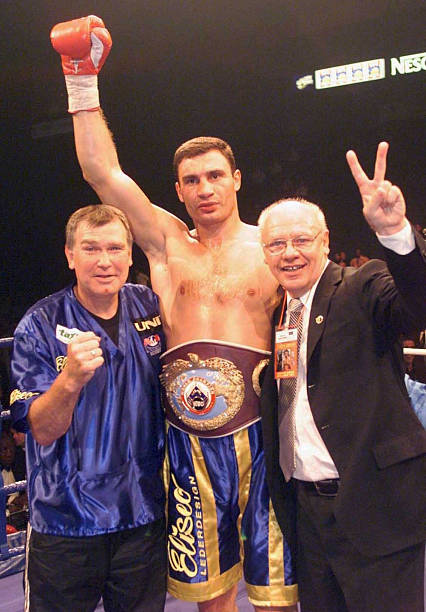
However, the narrative often shifts focus from the victor to the vanquished, particularly when a fighter chooses not to answer the bell. This was starkly evident on April 1, 2000, when Vitali Klitschko, a formidable figure standing at six foot eight and weighing 244 pounds, decided to discontinue a fight he was statistically winning against Chris Byrd. Klitschko’s physical advantages were undeniable, yet he chose to surrender, a decision that would echo through the annals of boxing history.
Twelve years later, Klitschko admitted to giving up during the third defense of his WBO heavyweight title, a title he had claimed from Herbie Hide in a swift victory in 1999. The fight against Byrd was a stark contrast, with Klitschko citing a shoulder injury as the reason for his surrender. Byrd, a middleweight who had transitioned to the heavyweight division, was a formidable opponent in his own right. His journey from the 1992 Olympic Games to the professional ring was marked by determination and adaptability, qualities that would serve him well against Klitschko.
Byrd’s path to the heavyweight division was not without its challenges. After not being paid for his first two professional bouts, he realized that to secure significant fights and financial rewards, he needed to bulk up and take his elusive style to the heavyweight division. His victory against Klitschko was a testament to his resilience and strategic prowess, qualities that larger heavyweights often underestimated at their peril.
The fight between Klitschko and Byrd serves as a poignant reminder of the complexities inherent in the sport of boxing. It underscores the fact that victory and defeat are not always straightforward, and that the decision to surrender can be as strategic as the decision to continue. This nuanced understanding is what makes boxing not just a physical contest, but a mental one as well.
As we reflect on this historic fight, it is essential to remember both the victor and the vanquished, for each plays a crucial role in the narrative of the sport. The story of Klitschko and Byrd is not just about a fight that ended in surrender, but about the resilience, strategy, and complexity that define the sport of boxing.
Team_TBE Boxing
🛒 Premium Recommendations

TCL 98 Inch Class QM8K Series | Mini LED QLED 4K HDR | 98QM8K, 2025 Model | 120HZ-144HZ Anti Reflective Wide Angle Screen Smart Google TV Dolby Atmos | Voice Remote Alexa Gaming Streaming Television

2026 eAhora Romeo Dual-Motor Ebike – 50Mph 5600W 60-80AH 250Miles Long Range Electric Bike for Adults, Full Suspension Hydraulic Brakes Electric Bicycle, 26" Mountain Bike for Off-Road Commuting
As an Amazon Associate, we earn from qualifying purchases. Prices and availability subject to change.